How to Build a VR Experience Around One Core Message
The best VR activations are not about the headset. They are designed backwards from a single message you need people to remember. Here is how to land that message in an interactive way.
Ask most teams why they want VR at their event and the answer is usually about the technology. "We want something cutting edge." "We want to wow people." "Everyone else has a screen, we want a headset." These are reasons to rent hardware, not reasons to build an experience.
The VR activations that actually move pipeline start somewhere completely different. They start with one sentence: the single thing you need every visitor to remember when they take the headset off. Everything else, the environment, the interaction, the story beats, is built backwards from that sentence.
Start With the Message, Not the Medium
Before anyone talks about headsets, hand tracking or haptics, answer two questions. What do you want people to remember? And why does it matter to them?
That memory has to be compressible into one short sentence. Not a paragraph. Not a list of features. One line a person could repeat to a colleague in the lift afterwards. If your team cannot agree on that line, you are not ready to design the experience yet.
A useful test: imagine a visitor describing your stand to their boss the next morning. What do you want them to say? Whatever that is, that is your core message. The VR experience exists to make that sentence unforgettable.
A Worked Example: Customer Experience
Say your company sells a customer experience platform and your differentiator is that you help brands create truly unique experiences for their customers. A brochure can say that. A sales deck can say that. Nobody remembers either.
Now imagine the VR version. A visitor puts on the headset and steps into a generic, grey, forgettable customer journey, the kind everyone delivers by default. Then, through interaction, they start reshaping it. They make choices, the world responds, and by the end they have built something unmistakably their own. The final beat shows them what they created and lands the line: this is what a truly unique experience feels like.
The visitor did not hear the message. They enacted it. That is the difference. The medium carried the message because the interaction was the message.
Design the Interaction So It Repeats the Message
The biggest mistake in VR event design is treating interactivity as decoration. Buttons to press, objects to grab, things to look at. Interactivity is not there to keep hands busy. It is there to repeat your core message in different forms.
A well structured experience lands the same message three or four times without ever saying it twice. The environment implies it. The first interaction demonstrates it. A moment of contrast reinforces it, showing the before and after, the ordinary and the exceptional. The finale states it explicitly, just as the headset comes off.
Each beat should feel different but point at the same idea. If any section of the experience does not serve the core message, cut it. Visitors spend two to four minutes in a headset at a busy event. You do not have time for anything that is not doing that job.
The Memory Structure That Works
Memorable VR experiences at events tend to share a simple three act shape, and it maps neatly onto message delivery.
The hook (first 20 seconds). Drop the visitor somewhere striking that frames the problem. Do not explain. Let the environment set the question in their mind. Confusion kills attention, but so does a lecture.
The participation (the middle). This is where the visitor does the thing. They make decisions, trigger changes and feel cause and effect. This is the section they will remember, because people remember what they did far better than what they were shown. Design two or three meaningful interactions, not ten trivial ones.
The payoff (final 30 seconds). Resolve the experience around the core message. Show the result of their choices, land the line visually and verbally, and give the team outside the headset a natural conversation opener for when the visor lifts.
Build for the Queue, Not Just the Wearer
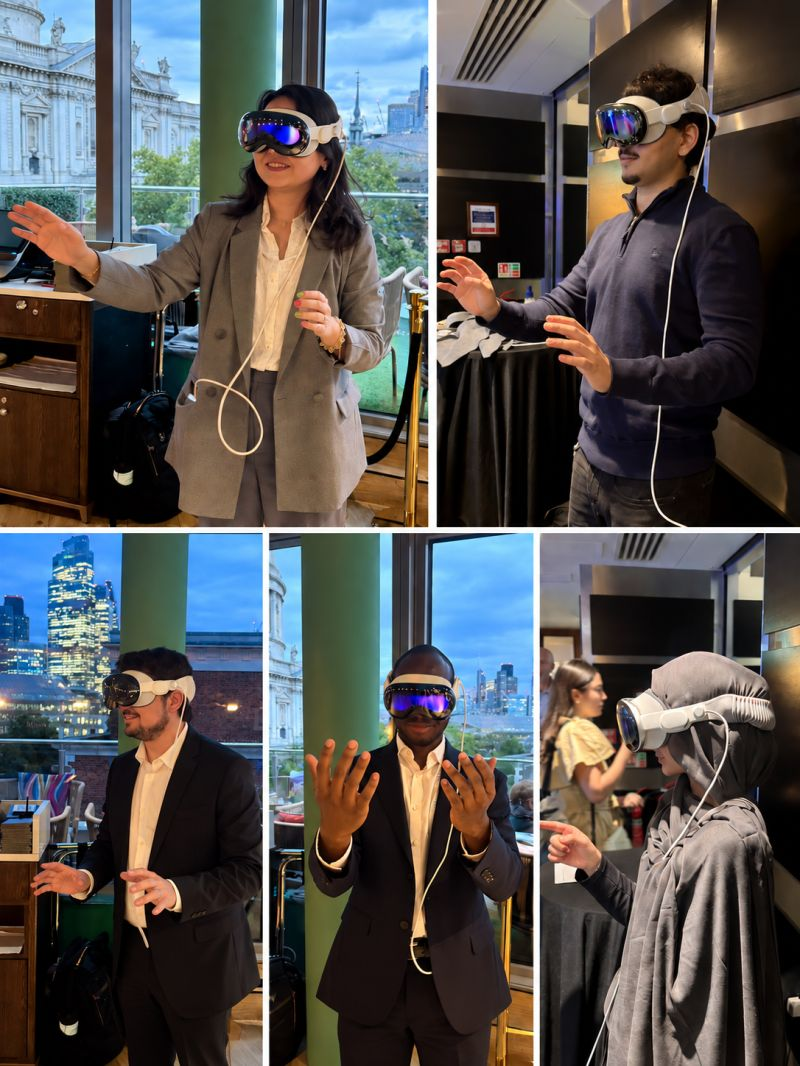
At an event, only one person wears the headset at a time. Everyone else is watching, waiting or walking past. A best in class activation treats the audience as part of the design.
Mirrored screens showing the wearer\u2019s view turn a solo experience into a spectator moment. Branded frames around the play space put your message in every photo. And the people waiting in line are a captive audience for the exact story the VR experience is about to land, so brief your staff to prime them with it.
This is also where your social content comes from. The reactions, the gestures, the moment someone reaches out to touch something that is not there. That footage feeds your online marketing for weeks, and it all carries the same core message the experience was built on.
Common Ways This Goes Wrong
Too many messages. If the experience tries to communicate five things, it communicates none. Ruthless prioritisation is the whole game.
Technology first. Choosing a headline grabbing feature and retrofitting a message to it produces experiences people describe as "cool" and nothing else. Cool is not a message.
No contrast. The most powerful storytelling device in VR is showing the before and after. If your experience only shows the good version, visitors have nothing to compare it against and the message loses its edge.
A weak ending. The final ten seconds are what people carry out of the booth. If the experience just stops, rather than resolving around the message, you have spent the budget and lost the point.
How to Brief Your Agency
When you commission a VR experience, lead with the message, not the tech spec. A strong brief sounds like this: "When the headset comes off, we need them to believe X, because Y. Everything else is flexible."
Give the agency the sentence, the audience, the setting and the time limit. Then judge every creative review against one question: does this moment make the core message more memorable, or is it just filling time? That discipline is what separates a VR activation people talk about from one they simply tried.
The Headset Is the Delivery Mechanism, Not the Idea
VR is uniquely good at one thing: making someone feel a message rather than hear it. That only happens when the experience is designed around a clear decision about what people should remember and why.
Decide the sentence first. Build every interaction to repeat it in a new form. End on it explicitly. Do that, and a two minute headset session will outperform an hour of demos, because the visitor will retell your message for you.