LED Panels for Immersive Tunnels: Turning Walkways Into Brand Environments
LED panels turn ordinary walkways into immersive brand tunnels. Learn how brands use LED tunnels to increase dwell time, memorability, and pipeline at trade shows and corporate events.
Most events treat walkways as dead space. A corridor between stands. A route from the entrance to the coffee. But the brands that understand spatial experience see them differently. They see a chance to surround a buyer before a single word has been spoken.
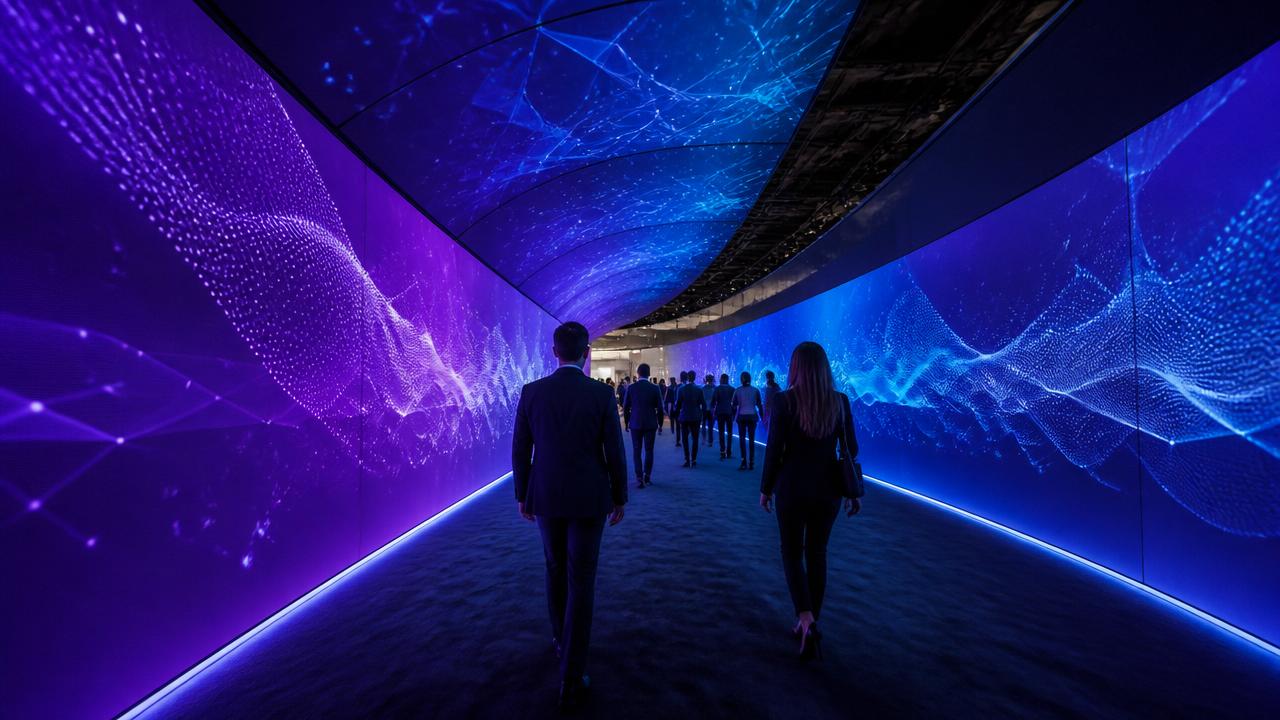
LED panels make that possible. By covering walls, ceilings, and floors with seamless video, you can turn any corridor into an immersive tunnel. The visitor does not look at the brand. They walk through it. That difference is exactly what makes LED tunnels one of the most effective formats in modern event design.
Why Tunnels Work
Tunnels create a psychological shift. The moment someone enters, the outside world disappears. The brain stops filtering the environment as background and starts treating it as the experience. That is a rare state at a busy trade show.
In normal conditions, buyers glance, evaluate, and move on. In a tunnel, they are carried forward. The content moves with them. The scale is unavoidable. The brand has their attention for the entire walk, which can be anywhere from twenty seconds to several minutes.
That duration matters. It is long enough to tell a story, introduce a product, or set an emotional tone. And because the visitor is moving through the space, the content can be sequenced. A beginning, a middle, and a reveal.
What LED Panels Bring
LED panels are the preferred medium for immersive tunnels because they solve the practical problems that projection and flat screens struggle with.
- Brightness. LED panels compete with show lighting and daylight, so the image stays vivid even in a busy exhibition hall.
- Seamless scale. Panels tile together to create walls and ceilings of almost any size without visible bezels breaking the image.
- Flexibility. Curved tunnels, angled walls, and floor extensions are all possible with the right panel specification.
- Reliability. LED panels are built for live events. They run for hours, handle movement, and are quick to repair or replace on site.
- Content control. The tunnel can switch from one brand story to another between sessions, or even respond to visitor motion.
The result is not just a screen. It is an architecture of light and content that becomes the brand environment.
Common Formats for Events
Immersive LED tunnels are not one fixed shape. They are designed around the space, the audience flow, and the message.
- Entry tunnels. The first brand moment at an event. Used to move visitors from a public hall into a controlled, branded environment.
- Product reveal corridors. A sequenced walk that introduces a challenge, then a solution, then a product at the end of the tunnel.
- Breakout zones. A short LED tunnel between a presentation space and a networking area, used to refresh attention and signal a shift in mood.
- Stand entrances. A smaller tunnel that pulls footfall from the aisle into a booth and filters out casual passers-by.
- Executive experience rooms. A private, high-end tunnel used for VIP briefings, partner meetings, or press previews.
The best format is always the one that fits the audience journey, not the one that looks most impressive in isolation.
How to Land the Message
The mistake is to treat the tunnel as a big screen. The opportunity is to treat it as a story that unfolds in space and time.
Because the visitor moves through the tunnel, the content can be paced. The opening frames should earn the stop. The middle should deepen the message. The end should leave a clear impression or a prompt for the next step.
- Make the first seconds visual, not verbal. Movement, colour, and scale stop people before they read a word.
- Sequence the message. Let the tunnel reveal layers as people walk, so the content rewards progress.
- Match the pace. Fast-paced content for a quick entry tunnel. Slower, more cinematic content for a longer experience.
- Design the exit. The end of the tunnel should hand people to a human, a demo, or a clear next action.
A well-designed LED tunnel does not just deliver content. It prepares the visitor for a conversation.
Where LED Tunnels Work Best
Not every event needs a tunnel. The format earns its place when the goal is to create a strong first impression, hold attention, or transform a transition into a brand moment.
- Trade show booths where you need to stop traffic and pull people in from a busy aisle.
- Product launches where the reveal should feel like an event, not just a slide.
- Annual conferences where the brand wants to own a corridor, foyer, or walkway.
- Press and partner events where the experience itself is the content.
- Executive briefings where a premium, controlled environment signals the brand's ambition.
The common thread is that the tunnel turns a transitional space into a memorable destination.
Practical Considerations
LED tunnels are achievable at a range of budgets, but they do require planning. The space must be suitable for rigging, power, and content delivery. The content must be created for the tunnel's exact dimensions and resolution. And the flow must be designed so visitors do not bottleneck at the entrance or exit.
- Content resolution. Tunnel content is large, so it needs to be created at the right pixel size from the start.
- Structural rigging. Panels on ceilings and curved walls require proper support and safety planning.
- Audio. Optional, but effective. Directional sound or a guided soundtrack can add depth without spilling into the hall.
- Lighting control. The tunnel should feel dark enough for the panels to dominate, but safe enough to walk through.
- On-site technical support. A technician should be present to manage playback, brightness, and any panel issues during the event.
With the right planning, a LED tunnel can be built and run without adding complexity to the event team.
The Real Advantage
Every brand is competing for attention. Most do it with words. A few do it with visuals. The rare ones do it with environment.
An LED tunnel is an environment. It surrounds the visitor, controls the pace, and delivers the message before a rep has to open their mouth. It turns the walk between A and B into a brand moment. And in an event where every aisle looks the same, a tunnel is a destination that people remember and talk about.
The goal is not to impress with scale. The goal is to walk someone into your message so naturally that by the time they reach the other end, they already believe it.
Frequently Asked Questions
What is an immersive LED tunnel?
An immersive LED tunnel is a corridor or walkway lined with LED panels on the walls, ceiling, or floor, displaying brand content that surrounds visitors as they walk through. It transforms a transitional space into a memorable brand experience.
Why are LED panels better than projection for tunnels?
LED panels are brighter, more reliable, and easier to scale without visible seams. They perform well under show lighting and can be built into curved, angled, or ceiling-mounted structures that projection would struggle to cover.
How long should an LED tunnel experience be?
Most effective event tunnels last between twenty seconds and three minutes. The right length depends on the message and the space. Short tunnels stop traffic and pull people in. Longer tunnels allow deeper storytelling and a stronger emotional shift.
Do LED tunnels work for events?
Yes. buyers respond to environments that signal quality, innovation, and confidence. A LED tunnel also gives a sales team a natural way to start a conversation, because the visitor has already experienced the brand before the introduction.
What content works best inside a LED tunnel?
Content that rewards movement. Motion, scale, and sequential storytelling work best. The tunnel should feel like a journey, not a slide deck. Open with strong visuals, reveal the message as visitors walk, and end with a clear impression or next step.
How much space do you need for a LED tunnel?
LED tunnels can be built at many scales. A small entrance tunnel can be three to four metres long. A larger experience corridor can run ten metres or more. The size should match the venue, the audience flow, and the story you want to tell.
Ready to Build Your Own Tunnel?
If you are planning a event and want to explore how a LED tunnel could work for your brand, we can help.
Book a free 30-minute strategy call. We will look at your event, your audience journey, and share practical ideas for turning a walkway into your most memorable brand moment.