Immersive vs Traditional: What Actually Makes an Event Immersive
Most events look different. Very few feel different. The real gap between a traditional and an immersive event is not budget — it is whether the audience watches, or stands inside the story.
Most events look different. Very few feel different. The gap between a traditional event and an immersive one is not budget or scale. It is whether the audience watches, or whether the audience is inside it.
The Traditional Event
The traditional format is familiar. A stage. A screen. Rows of seats facing forward.
Information flows one way. The brand talks. The audience listens.
It works. It is predictable, easy to brief, and easy to run.
But it asks very little of the people in the room. And people remember very little of what is asked of them passively.
That is the quiet problem with most events. They are well produced and instantly forgotten. The slides were sharp. The venue was smart. Nobody talks about it on Monday.
The Immersive Event
An immersive event removes the line between the audience and the experience.
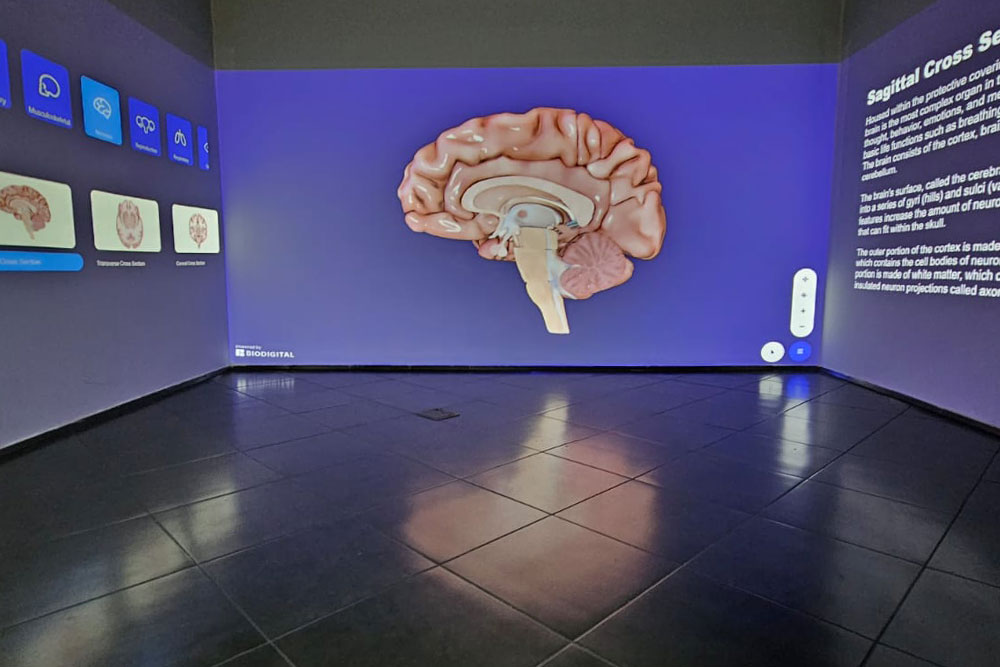
The space reacts. The visuals surround. The attendee moves, touches, and explores rather than sitting and absorbing.
There is no front of the room because the whole room is the message.
This is the difference between being shown a product and standing inside it. Between hearing a claim and feeling it. Between a presentation that happens to people and an environment that happens with them.
Immersive does not mean the attendee loses control. It means they gain agency. They choose where to look, what to approach, and how deep to go. That sense of choice is exactly what makes the experience stick.
What Actually Changes
The shift is not cosmetic. It changes the things that matter most at a event.
- Attention. Movement and depth hold focus far longer than a flat slide.
- Memory. People remember what they did, not what they watched.
- Emotion. Spatial experiences create feeling, and feeling is what gets repeated.
- Conversation. Shared experiences give people something to talk about together.
- Perception. The way you present signals how you think, and innovative formats signal an innovative brand.
A traditional event ends when the lights come up. An immersive event keeps living in the conversations afterwards.
A Worked Example
Picture two versions of the same product launch at a trade show.
The traditional version uses a looping promo video on a large screen behind the stand. The reel is polished. Attendees glance, slow for a second, and walk on. A handful stop for the live demo when a rep catches their eye. Footfall is steady but shallow. The team leaves with a stack of scanned badges and very little memory attached to any of them.
The immersive version replaces the screen with a reactive environment. A floating 3D model of the product rotates in real spatial depth, viewable by a group at once with no headset required. As someone steps closer, the environment responds and reveals the inside of the product, layer by layer. A second zone lets two or three people explore a miniature simulation of where the product lives in the real world.
The difference is not the budget. It is the behaviour.
In the immersive version, people stop without being prompted. They stay longer because there is something to discover, not just something to watch. They bring colleagues over. They start conversations with each other, which means the sales team is joining a discussion rather than starting a cold one. Dwell time goes up. So does recall. And weeks later, the attendee remembers the brand that let them stand inside the idea, not the one that played a video at them.
Same product. Same show. Two completely different outcomes.
It Is Not About Spectacle
Immersive does not mean loud, expensive, or complicated.
A holographic product. A reactive room. A 360 environment that explains a complex idea in seconds. These are immersive because they change how the audience relates to the content, not because they cost more.
Some of the most effective immersive moments are small. A single dimensional display in the right place can do more than a vast stage if it earns a stop and starts a conversation.
The goal is never novelty. The goal is understanding, retention, and relationships. Spectacle fades by lunchtime. A clear, felt idea stays.
Where Immersive Wins Most
Not every event needs to be immersive. The format earns its place when the stakes or the complexity are high.
- Product launches where you want the product understood, not just announced
- Complex or technical propositions that are hard to explain in a slide but obvious in three dimensions
- Executive and premium settings where perception and positioning carry real weight
- Crowded trade shows where the first job is simply stopping traffic
- Relationship-led sales where the experience is the start of a conversation, not the end of a pitch
If the aim is to be remembered and talked about, immersive does the job. If the aim is to tick a box, traditional will do.
The Real Distinction
A traditional event communicates.
An immersive event involves.
One is a message delivered. The other is a memory created.
For brands trying to stand out in a sea of stages and slide decks, that distinction is everything. It is the difference between being seen and being remembered.
Frequently Asked Questions
What is the main difference between an immersive event and a traditional event?
A traditional event presents content to a passive audience through stages, screens, and presentations. An immersive event surrounds the audience and invites participation, so people experience the content rather than simply watch it. The result is stronger attention, memory, and conversation.
Are immersive events more expensive than traditional ones?
Not necessarily. Immersive is about how the audience relates to the content, not how much is spent. A single well-placed dimensional display or reactive zone can outperform a large traditional stage at a similar cost.
Do immersive events work for , or only consumer brands?
They work especially well for . Complex propositions, premium positioning, and relationship-led sales all benefit from experiences that aid understanding and start conversations. In , that often matters more than spectacle.
What types of events suit an immersive approach best?
Product launches, technical or complex propositions, executive settings, and crowded trade shows where standing out is the first challenge. Anywhere the goal is to be remembered and talked about.
Does immersive mean everyone needs a headset?
No. Many of the most effective immersive formats, such as holographic displays, reactive rooms, and projection environments, require no wearables at all. This keeps the experience social and removes friction.