Immersive Office Spaces: How to Turn Your Building Into a Visitor Experience
Your office is more than a reception. Meeting rooms, boardrooms, breakout spaces and corridors are all opportunities to build immersive moments that impress visitors and reinforce your brand.
Most brands invest heavily in their website, their event stand and their sales deck. The building where real decisions happen, face to face, often gets left behind. A sofa in reception, a coffee machine and a logo on the wall are not a welcome. They are a missed opportunity.
An immersive office space changes that. It turns the time a visitor spends inside your building into a series of deliberate brand moments. Reception is only the beginning. Meeting rooms, boardrooms, breakout areas and even corridors can all carry weight if you design them with intent.
Your Building Is Your Most Undervalued Brand Asset
Your office is the only part of your marketing that every high value visitor sees in person. Investors, prospects, partners, recruits and press all move through it. Yet most buildings are designed for comfort and efficiency, not for impact.
The brands that win here treat the whole floor plan as a permanent activation. Not a waiting room. Not a corridor. A series of proof points that say, "This is what we build, this is how we think, and this is the level we operate at." That message lands long before anyone opens a laptop.
Multiple Rooms, Multiple Opportunities
Immersion is not one wall or one screen. It is a sequence of spaces, each doing a different job. When you map the visitor journey through your building, the opportunities become obvious.
Reception. The first sixty seconds. This is the space that sets the tone before a single word is spoken. An LED tunnel, a projection mapped feature wall or a hologram installation instantly signals ambition.
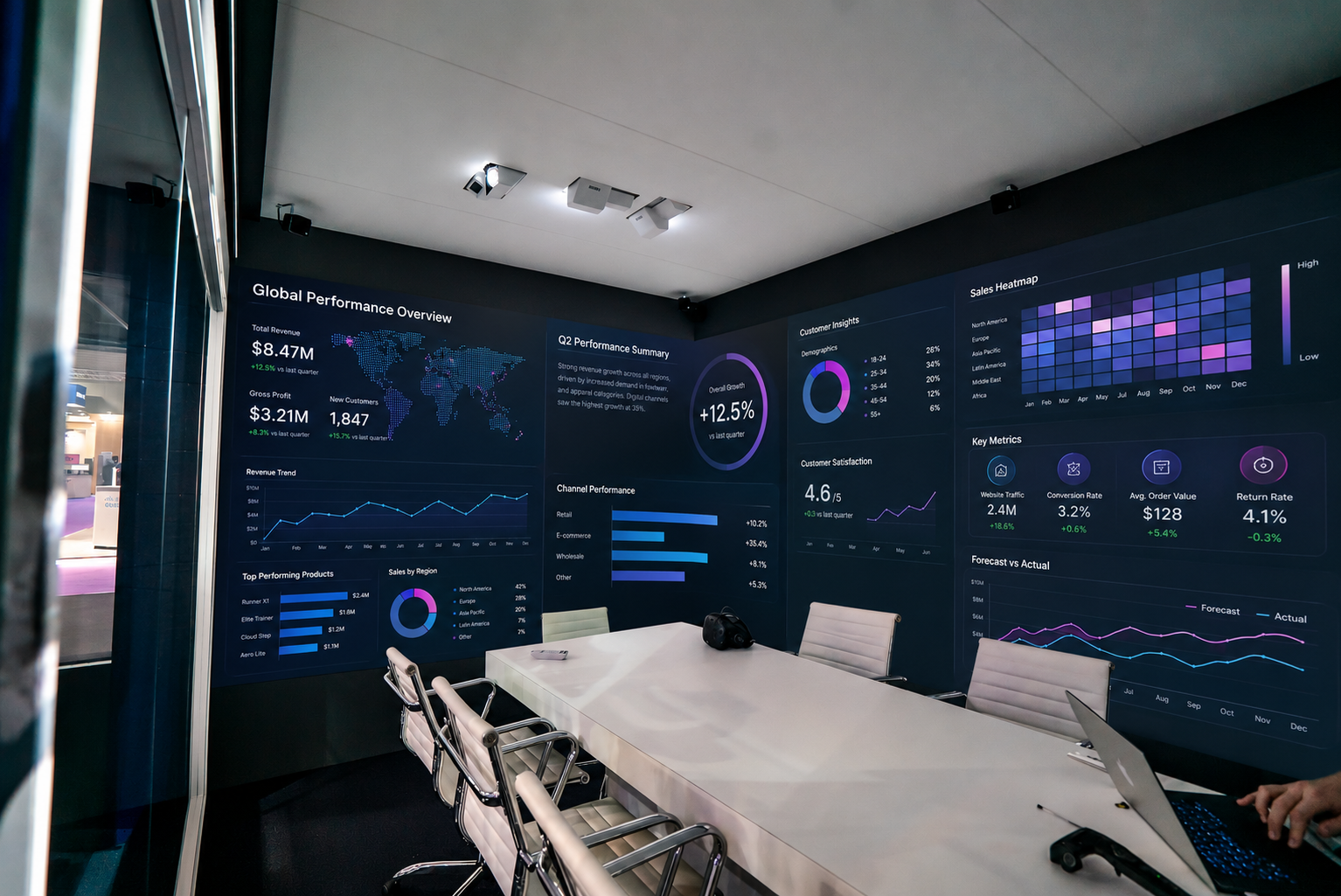
Meeting rooms. This is where most of the real conversation happens, yet most meeting rooms are neutral by design. Turning walls into live dashboards, brand storytelling surfaces or client specific content transforms a routine meeting into a memorable one.
Boardrooms. The highest stakes room in the building. Immersive boardrooms with wraparound displays, spatial audio and live data create a serious, executive grade environment for decisions that matter.
Breakout and social areas. The moments between meetings are where relationships are built. Interactive walls, generative art and ambient content give visitors something to talk about, photograph and remember.
Corridors and transitions. Often forgotten, corridors are the connective tissue of the visitor journey. Projection mapping, LED strips and motion triggered content turn dead space into brand narrative.
What Makes a Space Actually Immersive?
Immersion is not about adding screens for the sake of it. It is about using light, scale, sound and interactivity to make a visitor feel something specific about your brand.
The best immersive offices share a few traits. Each space has a clear focal moment. The technology is invisible or elegant, not intrusive. The content changes, so repeat visitors see something new. And the space is designed to be photographed, because a visitor who posts the space is doing your marketing for you.
Most importantly, the experience matches the business. A law firm might use calm, data driven projection walls in its boardroom. A technology company might build an LED tunnel in reception and live dashboards in its meeting rooms. A creative agency might turn its breakout area into an interactive canvas. The format follows the message.
The Technologies That Work in Real Offices
Almost every immersive format used at events can be adapted for an office environment. The difference is permanence and restraint.
LED volumes and tunnels. A curved or tunnel shaped LED structure signals scale and ambition. It works in lobbies, transition corridors and premium meeting rooms.
Projection mapping. Walls, columns, reception desks, meeting room walls and even floors can become canvases. Ideal where you want the architecture itself to feel alive.
Wraparound meeting room displays. Full wall screens turn a standard room into a briefing centre, product theatre or live data room. The same hardware supports many scenarios.
Holographic displays. Compact hologram units fit on desks or pedestals and work brilliantly for product models, executive messages or floating data visualisations.
Interactive touch and motion. Walls that respond to movement, screens that react to touch, and sensors that trigger content create participation rather than passive viewing.
Spatial audio. Directional sound zones let you create atmosphere without noise bleeding between rooms. A visitor hears your brand before they see the screen.
Designing for the Visitor Journey
A common mistake is designing each room in isolation. The question is not, "What do we want to show in reception?" The question is, "What should a visitor feel at each stage of their visit?"
The journey usually has four beats. Approach, pause, engage and depart. The approach happens at the entrance and reception. The pause happens as they take in the space. The engage beat happens in the meeting or boardroom where content, dashboards and visuals do part of the work for you. The depart beat is the final impression as they walk back through the building.
When these beats are choreographed across rooms, the office becomes a soft pitch. It does not replace your sales team. It warms up every room they walk into.
Content That Changes With Your Calendar
A static immersive installation dates quickly. The most effective spaces are content driven, with playlists that change by season, campaign or visitor type.
Launching a product? The reception becomes a product theatre and the meeting rooms carry supporting content. Hosting a global leadership offsite? The whole building welcomes delegates with a coordinated storyline. Recruiting senior talent? The content shifts to culture, people and vision. The same hardware serves multiple stories.
This is where the investment starts to compound. A single LED wall or projection surface can support hundreds of messages over its lifetime, making the cost per impression far lower than one off event builds.
The ROI of a Branded Environment
Measuring an office can feel intangible, but the impact is real. Visitors spend longer in the space. They ask questions. They take photographs. They mention the office in follow up calls. These are all pipeline signals.
There are also harder benefits. Recruitment becomes easier when candidates experience the brand rather than read about it. Press coverage is more likely when the space is visually distinctive. Client entertainment becomes simpler when the venue is already impressive. And the sales team gains a powerful setting for early stage conversations.
In competitive markets, the office visit is often the moment a prospect decides whether you are a serious partner or just another vendor. An immersive building tilts that decision before the meeting starts.
Keeping It Practical: Maintenance, Updates and Scale
Immersive office spaces only fail when they are treated as install and forget projects. Screens go dark, content goes stale and the whole thing starts to look like an expensive mistake.
The fix is operational. Build with commercial grade hardware rated for daily use. Plan a content calendar the same way you plan social media. Assign ownership internally or retain an agency retainer for updates. Schedule regular health checks for hardware, calibration and cleanliness.
Start small if needed. A single projection wall, one immersive meeting room or a hologram display can deliver impact without a full building rebuild. Prove the concept, measure the response, then expand room by room.
From Building to Pipeline
An immersive office is not an interior design project. It is a business development tool. Every visitor who walks through your reception, sits in your meeting room or presents in your boardroom is a potential lead, partner, investor or future employee. Every room either reinforces your position or undermines it.
The companies that get this right do not see their building as a cost. They see it as a permanent piece of brand real estate that works globally, every working day, for everyone who enters it.
Your next high value meeting will start in your lobby, continue in your meeting room and finish in your boardroom. Make sure every room has already done some of the selling for you.